Rabu, 25 Mei 2016

SIMILE

Definition simile
A Simile is a figure of speech that makes a comparison, showing similarities between two different things. Unlike a methapor, a simile draws resemblance with the help of the words “like” or “as”.Therefore, it is a direct comparison.

 We can find simile examples in our daily speech. We often hear comments like “John is as slow as a snail.” Snails are notorious for their slow pace and here the slowness of John is compared to that of a snail. The use of “as” in the example helps to draw the resemblance. Some more examples of common similes are given below.

Common Examples of Simile

  • Our soldiers are as brave as lions.
  • Her cheeks are red like a rose.
  • He is as funny as a monkey.
  • The water well was as dry as a bone.
  • He is as cunning as a fox.

Example #1

Written by joseph conrad,
“I would have given anything for the power to soothe her frail soul, tormenting itself in its invincible ignorance like a small bird beating about the cruel wires of a cage.”
The lines have been taken from Lord Jim. The helplessness of the soul is being compared with a bird in a cage beating itself against the merciless wires of the cage, to be free.

Example #2

In her novel To the Lighthouse, Virginia Woolf compares the velocity of her thoughts about the two men with that of spoken words.
“. . . impressions poured in upon her of those two men, and to follow her thought was like following a voice which speaks too quickly to be taken down by one’s pencil . . .”
She says both are difficult to follow and cannot be copied in words by a pencil.

Example #3

Taken from a short story Lolita written by Vladimir Nabokov,
“Elderly American ladies leaning on their canes listed toward me like towers of Pisa.”
This simile produces a humorous effect by comparing old women leaning on walking sticks with the ancient leaning tower of Pisa.

referensi; literarydevices.net/simile

IDIOM

Idiom is The term refers to a set expression or a phrase comprising two or more words. An interesting fact regarding the device is that the expression is not interpreted literally. The phrase is understood as to mean something quite different from what individual words of the phrase would imply. Alternatively, it can be said that the phrase is interpreted in a figurative sense. Further, idioms vary in different cultures and countries.

Functions of Idiom

Writers and public speakers use idioms generously. The purpose behind this vast use of idioms is to ornate their language, make it richer and spicier and help them in conveying subtle meanings to their intended audience.
Not only do idioms help in making the language beautiful, they also make things better or worse through making the expression good or bad. For example, there are several idioms that convey the death of a person in highly subtle meanings and some do the same in very offensive terms. They are also said to be exact and more correct than the literal words and sometimes a few words are enough to replace a full sentence. They help the writer make his sense clearer than it is, so that he could convey maximum meanings through minimum words and also keep the multiplicity of the meanings in the text intact.


Idiom Examples

Example #1

“Every cloud has its silver lining but it is sometimes a little difficult to get it to the mint.”
The statement quoted above uses “silver lining” as an idiom which means some auspicious moment is lurking behind the cloud or the difficult time.

Example #2

“American idioms drive me up the hall!”
Here, the word “idioms” is used as an idiom.

Example #3

“I worked the graveyard shift with old people, which was really demoralizing, because the old people didn’t have a chance in hell of ever getting out.”
In the extract quoted above, “graveyard shift” is employed as an idiom.

referensi:http//wikipedia.org


Jumat, 13 Mei 2016

proverb

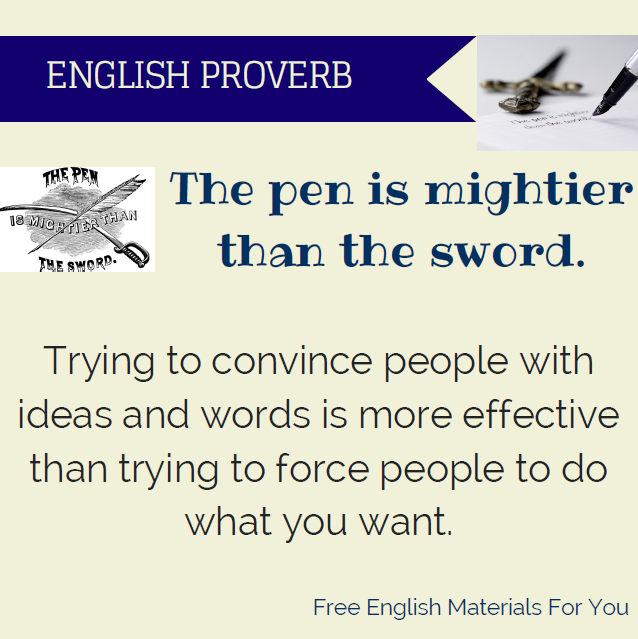
A proverb is a simple and concrete saying, popularly known and repeated, that expresses a truth based on common sense or experience. They are often methaporical. A proverb that describes a basic rule of conduct may also be known as a maxim. Proverbs fall into the category of fourmulaic language.
Proverbs are often borrowed from similar languages and cultures, and sometimes come down to the present through more than one language.

Proverb Meanings

"The best things in life are free."
We don't have to pay for the things that are really valuable, like love, friendship and good health.
"A stitch in time saves nine."
Repair something as soon as it is damaged. That's a small repair job. If not, you will have a much bigger and more expensive repair job later. Do it now and you'll need one stitch. Do it later and you'll need 9 stitches! (Why nine and not eight or ten? Because "nine" rhymes, approximately, with "time".)
  • stitch (noun): a link made with thread in sewing
  • in time: not late
"He teaches ill, who teaches all."
The unusual structure of this proverb may make it difficult to understand. It becomes easier if we change the structure to "He who teaches all teaches ill." The word "ill" here means "badly". So it means that the teacher who teaches students everything, does not teach well. A good teacher lets students discover some things for themselves.
  • ill (adverb): badly
"You can't take it with you when you die."
When we die we leave everything on earth. We don't take anything with us. Even the richest people cannot take their money with them after death. This proverb reminds us that some material things are not really so valuable as we think.

 A proverb is both a functional means of communication and also a very elegant and artistic
performance itself  So, when I use these forms in my novels, they both serve a utilitarian
purpose; which is to re-enact the life of the people that I am describing and also delight through
elegance and aptness of imagery.

Given that proverbs are strictlycontext-dependent, it is essential to explore them in terms ofhow their meanings emerge in situations of use According to Firth (1926: 134):
The essential thing about a proverb is its meaning,The meaning of a proverb is made clear only when side by side with the translation is given a full account of the accompanying social situation the reason for its use, its effects, and its significance in speech.


 examples:
 Killing two birds with one stone –> Sekali dayung dua tiga pulau terlewati/ Sambil menyelam       minum air
– No use crying over the spilt milk –> Nasi sudah jadi bubur
– Even homers sometimes nod -> Sepandai-pandainya tupai melompat, akhirnya jatuh juga
– The grass is always greener on the other side –> rumput tetangga lebih hijau
– Your tongue is fire –> mulutmu harimaumu

references:- https://www.englishclub.com/reading/proverbs-meaning.html
                  - https://en.wikipedia.org/wiki/Proverb.


methonyms

A metonyms is a figure of speech used in rhetoric in which a thing or concept is not called by its own name, but by the name of something intimately associated with that thing or concept. For instance, "Westminster", a borough of London in the United Kingdom, could be used as a metonym for the country's government.

 One of the four master tropes, metonyms have traditionally been associated with methapors. Like metaphors, metonyms are figures of speech used in everyday conversation as well as in literature and rethorical texts. But whereas a metaphor offers an implicit comparison, a metonym is a part or attribute of a thing that represents the thing itself.

  metonymy also comes in a compound-word form. While the compound metaphor makes a fanciful figurative comparison between two unlike realms ('snail mail'), a compound metonym, in distinction, characterizes a single domain by using an associated literal attribute as a characterizing adjective, for example, coffee-table book: a (usually expensive) large-format book that is too big to fit on a bookshelf, thus it's displayed on a table--effect for the cause. A compound metonym--usually two or three words--can be readily distinguished from a compound metaphor by a definition that always begins one that, one who, those which, and is followed by a significant quality or attribute


Image result for contoh gambar metonymy


Examples and Observations

"The part that is chosen to be a metonym of its whole is not arbitrary. Such a part must be in some sense outstanding, easily recognizable, and play a unique role in the whole. . . . A steering wheel would be a good metonym for driving, a violin a good metonym for a classical orchestra, bread a good metonym for a baker's shop, a file folder a good metonym for organizing documents in a computer.

"Metonyms provide the basis for a human-centered theory of signs. Traffic signs, for examples, might employ pictograms of the road, a car, bicycle, or pedestrian, but they do not represent anything beyond the part-whole relationship."


 References:
 Traugott, Elizabeth Closs; Dasher, Richard B. (2002).regularity in semantic change . Cambridge University Press.ISBN 9781-139-43115-6. Retrieved 6 August 2013.